December 8, Int. Dignified Menstruation Day
Frequently Asked Questions (FAQ) on Dignified Menstruation
- What is menstrual discrimination?
Menstrual discrimination is an umbrella term that includes silence, taboos, stigma, shyness, restrictions, abuse, violence, exclusion, and the denial of resources and services associated with menstruation throughout the life cycle of menstruators in diverse settings. Most importantly, it contributes to the construction and socialization of unequal power, patriarchy, and exclusion.
- Isn’t menstrual discrimination an issue only in poor countries?
No. Not at all. The names, norms, forms, and magnitude of menstrual discrimination vary from person to person, culture to culture, and country to country. However, menstrual discrimination is practiced across the globe regardless of class, ethnicity, religion, or region.
- Why is menstrual discrimination a human rights issue?
Because discriminatory menstrual practices interrupt or violate at least four human rights: the right to dignity, the right to equality, the right to freedom, and the right to non-discrimination. For example, hiding menstrual pads or preventing participation in cultural activities can undermine these rights. Additionally, menstrual discrimination may violate other rights, including the rights to health, education, participation, a healthy environment, and the rights of the child.
- Why and how is menstrual discrimination a form of sexual and gender-based violence (SGBV)?
Yes, it is. The United Nations (1993) categorizes SGBV into four forms: emotional, sexual, physical, and deprivation of services and resources. According to this framework, discriminatory menstrual practices may fall under two or more of these categories.
For example, hiding menstrual pads may constitute emotional violence and deprivation of services and resources. In some cases, it may also be associated with sexual violence. Similarly, restrictions on participation in cultural activities may have comparable impacts.
GSCDM/RPF argues that menstrual discrimination is both a cause and a consequence of many forms of SGBV because of its role in constructing and shaping unequal power relations, patriarchy, and exclusion from childhood onward.
- What is Dignified Menstruation?
Dignified Menstruation is a concept and approach that refers to a state of freedom from all forms of menstrual discrimination, including silence, taboos, stigma, shyness, shame, restrictions, abuse, violence, and the deprivation of resources and services throughout the life cycle and across diverse settings, with the aim of cultivating equality, inclusion, and dismantling patriarchy. In other words, it is a decolonial, holistic, human rights-based, and life-cycle approach.
- What is International Dignified Menstruation Day?
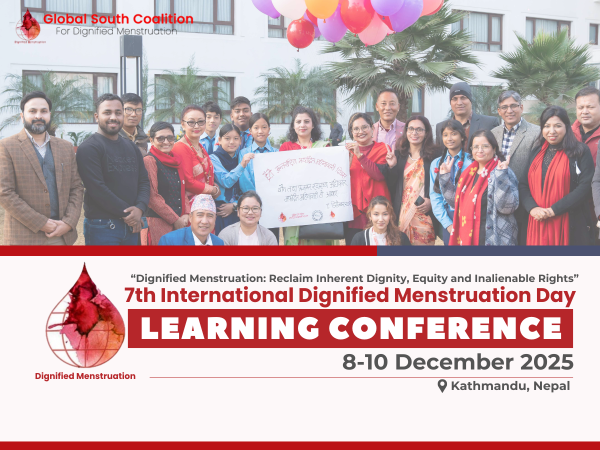
International Dignified Menstruation Day is observed annually on 8 December to review progress, celebrate achievements, identify gaps and challenges, and move forward with determination and solidarity among those who believe that menstrual discrimination is both a cause and a consequence of sexual and gender-based violence and a violation of human rights including its role in constructing unequal power, patriarchy, and exclusion before the emergence of religion, philosophy, ethnicity, or class.
- Why is International Dignified Menstruation Day observed on 8 December?
Menstrual discrimination is a human rights violation and a form of sexual and gender-based violence (SGBV). The date also falls on the 14th day of the global 16 Days of Activism Against Gender-Based Violence.
- When did Dignified Menstruation Day begin?
It has been observed since 2019.
- Where was Dignified Menstruation Day initiated?
It was initiated in Nepal in 2019.
- Which organization initiated it?
The Radha Paudel Foundation, a Nepal-based NGO, and its global network, the Global South Coalition for Dignified Menstruation, jointly initiated this day.
- Who is leading this initiative?
The initiative is led by Radha Paudel from Nepal, a survivor of menstrual discrimination, nurse, and author.
- Did Dignified Menstruation begin only in 2019?
The international observance of Dignified Menstruation Day began in 2019. However, the Government of Nepal endorsed the concept of Dignified Menstruation in 2017 through the National Policy on Dignified Menstruation. This marked a significant milestone, reflecting recognition of Radha Paudel’s more than four decades of advocacy, experience, and commitment to dignified menstruation.
- Is Dignified Menstruation included in The SAGE Encyclopedia of Menstruation and Society (2026)?
Yes. Dignified Menstruation is included in the encyclopedia. The chapter was primarily authored by Radha Paudel, Samiksha Koirala, and Mili Adhikari. DOI: 10.4135/9781071938164.n34
- Isn’t there already an international day for menstruation instead of 8 December, International Dignified Menstruation Day?
No. There is no international day that addresses all forms of menstrual discrimination throughout the year and explicitly recognizes menstrual discrimination as both a form of SGBV and a human rights violation within the framework of the 16 Days of Activism Against Gender-Based Violence.
An observance on 28 May was initiated in 2014 by WASH United, a Germany-based NGO, with a primary focus on products, sanitation, and menstrual management. Many organizations now mark this day as Menstrual Health Day rather than Menstrual Hygiene Day, recognizing concerns that the term “hygiene” may reinforce perceptions of menstrual blood as impure or dirty.
Dignified Menstruation address all forms of menstrual discrimination including climate, products, WASH, menstrual management.
- Is Dignified Menstruation only about five days of bleeding?
No. Dignified Menstruation is a life-cycle approach that addresses menstrual discrimination and its impacts from birth to death, and in some cultures, even beyond death.
- Who can participate in International Dignified Menstruation Day?
Everyone.
Governments, schools, communities, workplaces, media, civil society organizations/networks, youth groups, menstruators, and non-menstruators all have a role in ending menstrual discrimination.
- Why does Dignified Menstruation use the terms “menstruators” and “non-menstruators”?
Dignified Menstruation seeks to address exclusion and intersectionality. Therefore, it recognizes the important roles of both menstruators and non-menstruators in advancing equality and ending menstrual discrimination.
- What is the main message of International Dignified Menstruation Day?
Menstruation is more than a matter of products, management, or infrastructure. It is a matter of dignity, equality, justice, and human rights, approached through a decolonial lens.
- Why does the world need a separate day for Dignified Menstruation?
Before 2019, no international observance addressed all forms of menstrual discrimination and their impacts. Given the widespread nature of menstrual discrimination worldwide, a paradigm shift is needed to address it comprehensively, and Dignified Menstruation offers such an approach.
- Why was 8 December chosen for Dignified Menstruation Day?
Observing 8 December is not merely about marking another international day. The date was chosen because menstrual discrimination is both a cause and a consequence of SGBV, and 8 December falls on the 14th day of the 16 Days of Activism Against Gender-Based Violence.
In addition, menstrual discrimination is a human rights issue, and December is widely recognized as Human Rights Month. The date is also close to Human Rights Day on 10 December. For these reasons, 8 December was chosen as International Dignified Menstruation Day.
- Is Dignified Menstruation relevant only in Nepal or South Asia?
No. Not at all. Menstrual discrimination is practiced worldwide in various forms, regardless of class, religion, region, education, or culture. Therefore, Dignified Menstruation is globally relevant.
- Do the UN, donors, and governments know about the concept of Dignified Menstruation?
Yes. There are volunteers, chapters, and advocates of Dignified Menstruation across the world. The steering committee of the Global South Coalition for Dignified Menstruation includes members from Bangladesh, Indonesia, South Africa, Sri Lanka, Pakistan, the Philippines, Malawi, Uganda, and the United States. In addition, more than 95 member organizations are affiliated with the coalition globally.
Radha Paudel has consistently raised the urgency of Dignified Menstruation through global, regional, and national platforms. These efforts contributed to the establishment of the GSCDM and the observance of International Dignified Menstruation Day on 8 December since 2019.
- Are there resources available to learn more about Dignified Menstruation?
Yes. The website www.dignifiedmenstruation.org provides books, policy papers, appeals, petitions to the United Nations, and other resources related to Dignified Menstruation.
- Is Dignified Menstruation relevant to climate justice, pandemics, or humanitarian settings?
Yes. Dignified Menstruation is relevant across sectors and contexts worldwide because menstruators exist everywhere. Given the role of menstrual discrimination in constructing and shaping unequal power, patriarchy, and exclusion, Dignified Menstruation is relevant wherever there are efforts to promote equality, inclusion, and the dismantling of patriarchy.
- What progress has Nepal made on Dignified Menstruation?
Nepal has made important advances in both policy and programming. Key milestones include the National Policy on Dignified Menstruation (2017 draft), the Menstrual Law (2017), and the Resolution Motion on Dignified Menstruation (2025). However, significant challenges remain.
- Has the Gender Equality and Social Inclusion (GESI) framework already addressed Dignified Menstruation?
No. Not fully. From the United Nations to local governments, GESI frameworks have yet to comprehensively address Dignified Menstruation or menstrual discrimination. While some recent policies and documents have incorporated menstrual health or menstrual hygiene, they do not address all forms of menstrual discrimination in the holistic manner envisioned by Dignified Menstruation.
- Have there been efforts to seek UN endorsement of International Dignified Menstruation Day on 8 December?
Yes. Since 2019, RPF and GSCDM have engaged with the United Nations through virtual and in-person advocacy, as well as through collaboration with the Government of Nepal. They have continuously raised this issue through global and regional platforms and have appealed for international recognition of International Dignified Menstruation Day.